
Converting an Asset to An Income Stream with a CRT

Investors sometimes find themselves “locked in” to investments they would rather sell. They hold low-yielding, highly appreciated property—such as real estate, marketable securities, etc.—but they balk at selling these assets because of the capital gains tax liability that would result.
A charitable remainder trust (CRT) can be a solution that will help investors escape taxes, generate retirement income and meet personal philanthropic goals.
What is a Charitable Remainder Trust?
A CRT is a “split-interest” gift in which the trust pays an income to the donor (or someone chosen by the donor) for a number of years, then distributes the remainder of the trust assets to a designated charity. The income payout from the CRT may last for up to 20 years or for the lifetime of the named non-charitable beneficiaries. The trust must make income payouts at least annually, and when the trust term expires, the named charity receives the remaining assets.
What Are the Advantages?
By transferring an appreciated asset to a CRT, a donor can convert an underperforming asset into an income stream. The typical result is:
- A dramatic increase in the donor’s income
- Deferral of capital gains taxes on both the transfer and the subsequent sale of the property by the CRT
- An immediate federal income tax charitable deduction (subject to limitations) for donors who itemize
- The personal satisfaction that comes from making a significant contribution to charity
What Are the Potential Disadvantages?
Before setting up a CRT, donors should carefully consider that CRTs are:
• Irrevocable. The donor has no control over the assets once they are transferred into the trust.
• Complex. Professional services are necessary to ensure compliance with all rules and requirements, which adds another layer of expense and makes them best suited for substantial gifts. Donors wishing to make smaller gifts should consider whether a charitable gift annuity or other simpler gift option might be a better fit.
• Gifts. Yes, these gifts come with tax and income benefits, but if the IRS believes a donor is misusing a CRT to evade taxes or hide capital gains, the consequences can be severe.
A Dilemma
Some investors find themselves “locked into” assets they would rather sell. They own highly appreciated, low-yielding, non-performing assets (real estate or marketable securities) they are reluctant to sell because of the capital gains tax that would be incurred.
Example: John bought a parcel of real estate several years ago that has more than doubled in value, but produces no income. John knows if he sells the property, he’ll incur capital gains taxes. Even if he succeeds in investing the after-tax proceeds for a higher return, the tax drain will significantly deplete his wealth.
A Solution
A charitable remainder trust (CRT) is an effective way to escape a “locked-in” position while meeting charitable giving goals.
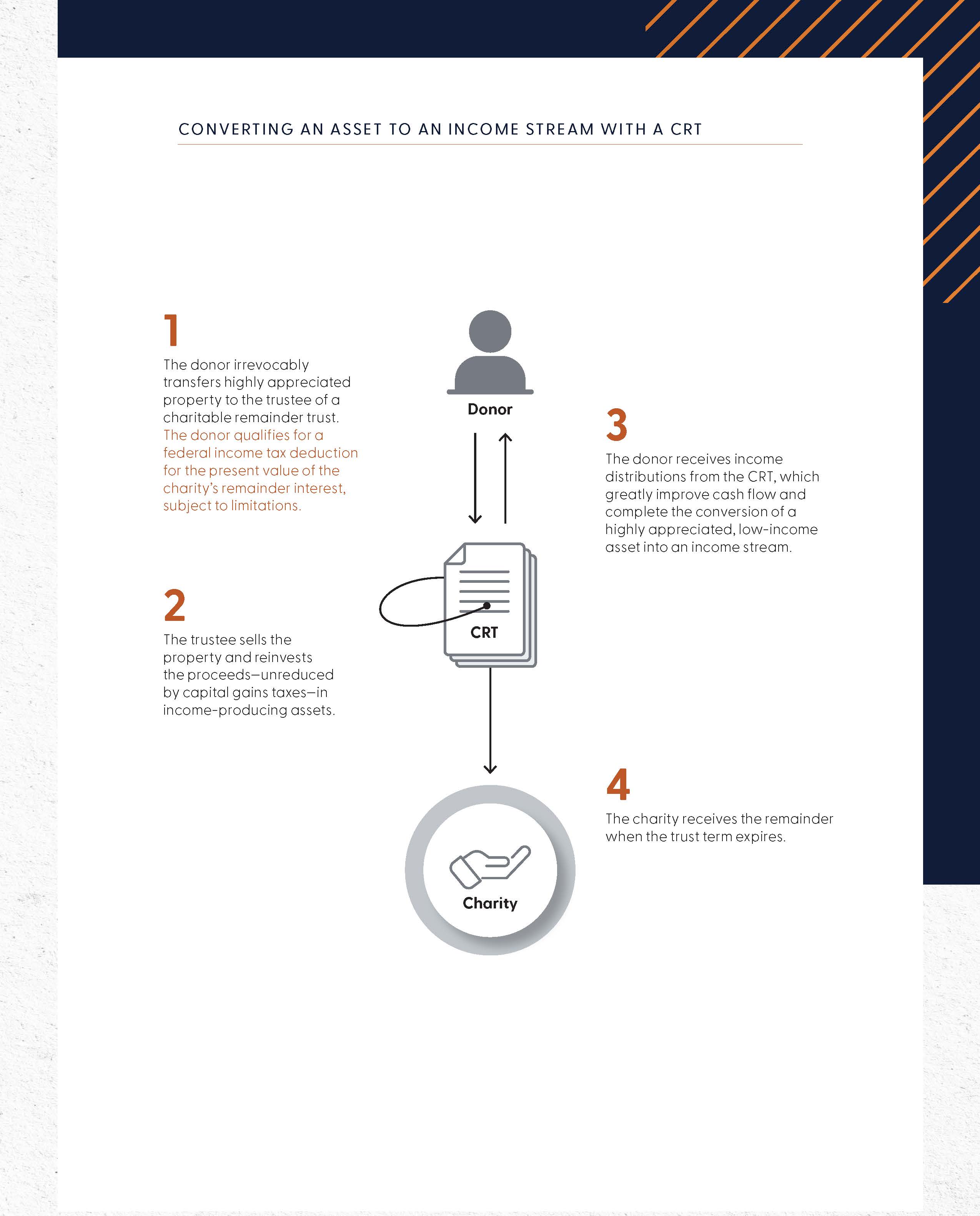
A CRT is a “split-interest” gift in which the trust pays an income to a donor (or someone else chosen by the donor) for a number of years. When the trust terminates, trust assets are distributed to a designated charity.
Income payouts must be made at least annually from the trust, and may last for a specified term (up to 20 years), or for the lifetime of the named non-charitable beneficiaries.
The Process
• Selling appreciated assets results in capital gains tax liability. The top federal tax rate runs from 20% for most capital assets held more than one year, to 25% on certain depreciable real estate, to 28% on collectibles held more than a year, to 37% for capital assets held for one year or less. Plus, higher-income taxpayers pay a 3.8% surtax on all net investment income—which includes capital gains.
• By contrast, appreciated property transferred to a CRT is not subject to capital gains tax when the donor transfers property to the trust, nor when the trustee sells the property. However, when the trust makes annual income payouts, a portion may be taxed as a long-term capital gain to the recipient.
• Example: John purchased real property for $125,000 several years ago. Today, it is worth $325,000. John could incur long-term capital gains tax of as much as $47,600 if he sold the property, resulting in only $277,400 of after-tax proceeds to invest. Alternatively, John can transfer the property to a CRT, defer these taxes and fund the trust with the full $325,000.
• After a CRT sells appreciated property, it can reinvest the proceeds. In addition, the donor may qualify for a federal income tax charitable deduction based on the present value of the charity’s remainder interest. The donor can invest this tax savings as well as receive the income payout from the CRT, resulting in a potentially sizable increase in cash flow.
Example: John transfers appreciated property to a CRT that will pay him 6% of the trust’s initial value every year. If John itemizes, he receives an immediate income tax charitable deduction that produces significant tax savings in his tax bracket, subject to certain limitations. He can also invest his tax savings and earn additional income.
The Tax Picture
Normally, selling appreciated assets results in capital gains tax liability on the excess of the selling price over the seller’s basis. The top federal tax rate on realized capital gains ranges from a top rate of 20% for most capital assets held for more than one year, to 25% on certain depreciable real estate, to 28% for collectibles held more than a year, to 37% for assets held for one year or less. Plus, higher-income taxpayers pay a 3.8% surtax on all net investment income, and that includes capital gains.
By contrast, appreciated property transferred to a CRT is not subject to capital gains tax when the donor transfers property to the trust, nor when the trustee sells the property. It is important to note that part of each annual income payout may be taxed as capital gain to the donor.
After a CRT sells the appreciated property without incurring capital gains tax, it can invest the proceeds. In addition, the donor may qualify for a federal income tax charitable deduction based on the present value of the charity’s remainder interest.
The overall benefit directly related to the donor’s initial gift of low-yielding appreciated property to a CRT can be substantial—steady income payouts from the CRT, tax savings, and the personal satisfaction that comes with making a significant gift to charity.
Summary
With a CRT, a donor can convert an appreciated asset into an income stream, which can dramatically increase the donor’s income by deferring capital gains taxes on the property transfer and on the trust’s subsequent sale of the property. The donor also qualifies for an immediate federal income tax charitable deduction (subject to limitations) for the present value of the charity’s interest, and can invest the savings to generate additional income. And, the donor enjoys the satisfaction of making a significant gift to charity.
The Bottom Line
Transferring highly appreciated, non-income-producing property to a CRT, and enjoying the resulting federal tax savings, can accomplish the twin goals of building more retirement income while making a substantial gift to charity.
This content is developed from sources believed to be providing accurate information, and provided by Wealth Manager Group. It may not be used for the purpose of avoiding any federal tax penalties.
This information is not intended to be a substitute for specific individualized tax, financial or legal advice. We suggest that you discuss your specific situation with a qualified tax, financial, or legal advisor.
The opinions expressed and material provided are for general information, and should not be considered a solicitation for the purchase or sale of any security.